
Short answer: The darkest bedroom option is a blackout roller shade or blackout cellular shade with side channels, which seal the light gaps at the edges. Blackout cellular also insulates, making it the best choice for cold bedrooms. Zebra blinds, sheer shades and slatted blinds are not true blackout. For nurseries, choose cordless or motorized.
Key takeaways
- Blackout fabric blocks light; edges are where light gets in.
- Side channels or an outside mount fix the edges.
- Blackout cellular is darkest and warmest together.
- Room darkening is not blackout.
- In Atlantic Canada, June sunrise before 5:30 a.m. makes blackout worth it.
Why this matters more in Atlantic Canada
On June 21 the sun rises at about 5:29 a.m. in Halifax, 5:28 a.m. in Moncton, 5:21 a.m. in Charlottetown, 5:03 a.m. in St. John's and 4:34 a.m. in Happy Valley-Goose Bay. It sets after 9 p.m. almost everywhere, close to 10 p.m. in Labrador City.
That means a light-filtering bedroom is bright at bedtime for months, and bright again before anyone wants to be awake. Children, shift workers, light sleepers and anyone with migraines feel it most.
Blackout vs room darkening
Room darkening fabric blocks most light, typically 95% to 99%. The room is dim, with a soft glow.
Blackout fabric blocks essentially all light passing through it, usually with a coating or an internal liner.
For a TV room or guest room, room darkening may be enough. For a nursery or a shift worker's bedroom on a June afternoon, the difference is obvious.
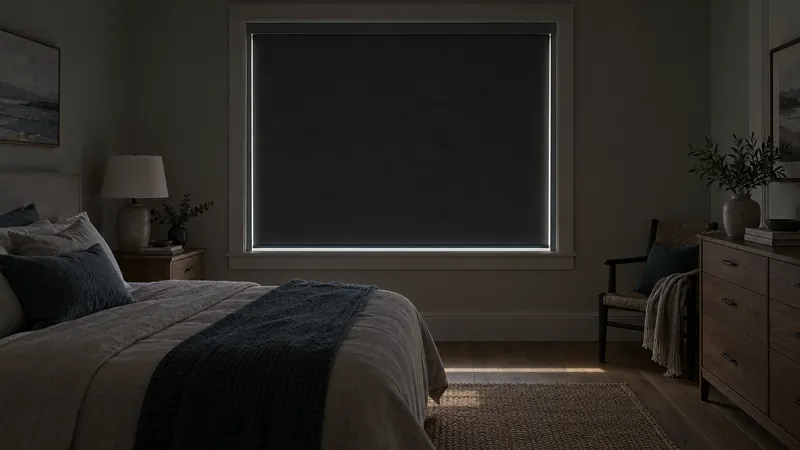
The real problem: light gaps
Here is what no one tells you in the store. Even a perfect blackout fabric leaves a room partly lit if light gets around it. With an inside-mounted shade, you will usually see:
- a thin bright line down each side,
- a strip of light across the top, over the roll,
- a glow along the bottom.
How to close them:
- Side channels. Slim tracks along each side that the shade runs inside. The biggest single upgrade.
- Outside mount. Mount the shade on the wall, overlapping the opening by 5 to 8 cm each side.
- Cassette or valance. Covers the top of the roll.
- A bottom rail that sits on the sill.
The best blackout options, ranked
1. Blackout roller shade with side channels
The darkest result available in a standard window covering. Clean look, easy to motorize, wide range of colours. Roller shades.
2. Blackout cellular shade with side channels
Very nearly as dark, and much warmer. A blackout liner inside insulating honeycomb cells. Our top pick for cold bedrooms in older homes, and in Labrador and exposed coastal homes. Cellular shades.
3. Roman shade with blackout lining, outside mounted
Dark and soft, with a tailored look that suits heritage homes and primary bedrooms. A little light at the edges unless mounted generously. Roman shades.
4. Dual roller shade
A light-filtering or solar shade in front and a blackout shade behind, on one bracket. Bright by day, dark by night.
Not true blackout
- Zebra blinds: gaps between bands.
- Sheer shades: designed to filter, not block.
- Wood, faux wood and aluminum blinds: light passes between slats and through cord holes.
Nurseries and kids' rooms
Two non-negotiables:
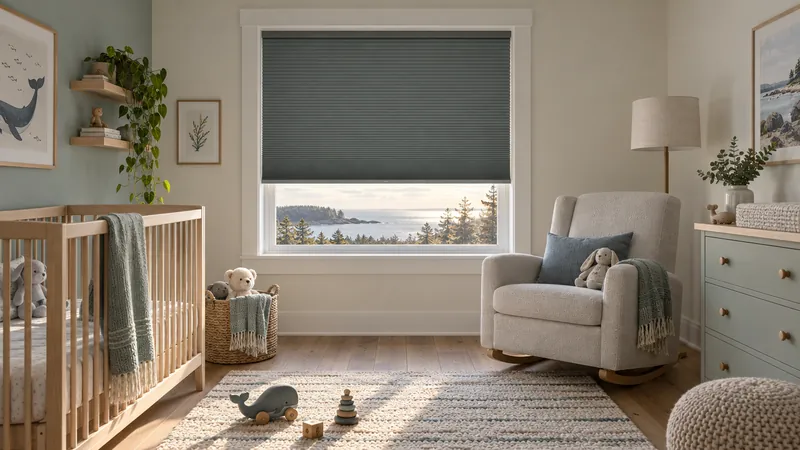
No reachable cords. Health Canada's rules limit any reachable cord to 22 cm and any reachable loop to 44 cm around, sized to protect a one-year-old. The simplest way to comply and be safe is cordless or motorized shades. Child-safe blinds.
Real darkness for daytime naps. Blackout with side channels. Many parents also choose motorized shades on a schedule, so the room darkens for naps without anyone sneaking in to pull a cord.
Bonus: blackout cellular keeps the room warmer on winter nights.
Shift workers
Nurses at the Infirmary or the Health Sciences Centre, paramedics, port and plant workers, military, anyone sleeping through daylight: blackout roller or cellular with side channels, and a cassette at the top. Add a motor with a schedule so the room is dark when you get home and opens when you need to be up.
How we approach this at Atlantic Shades
At a measure, we look at each bedroom's orientation. East-facing bedrooms get the early June sun; west-facing ones get the late evening sun. We recommend side channels where darkness matters most and an outside mount on older frames. Every shade is made to measure in our Halifax workshop, which is what lets side channels fit tightly enough to work.
See blackout solutions · Book a free measure
Frequently asked questions
What is the best blackout blind for a bedroom?
A blackout roller shade or blackout cellular shade with side channels. Side channels seal the light gaps at the edges, which is where most light enters. Blackout cellular is also insulating, which helps in cold bedrooms.
Why do my blackout blinds still let light in?
Light is getting around the edges, not through the fabric. Add side channels, switch to an outside mount that overlaps the frame, or add a cassette to cover the top.
Are blackout blinds safe for babies?
Yes, if they are cordless or motorized with no reachable cords. All corded window coverings sold in Canada must meet Health Canada's cord length rules, but cordless is the safest choice in a nursery.
Do blackout blinds help keep a room warm?
Somewhat, and blackout cellular shades help a lot, because they combine a blackout liner with insulating air pockets.
Is room darkening good enough for a nursery?
Usually not in Atlantic Canadian summers. With sunrise before 5:30 a.m. and sunset after 9 p.m., room-darkening fabric often leaves enough light to wake young children.
Related: Corded blinds rules in Canada · Are cellular shades worth it? · Zebra blinds vs roller shades