
Short answer: The best window coverings for heritage homes respect the architecture and fix the drafts: plantation shutters, lined Roman shades, real wood blinds and inside-mounted cellular shades. Measure every window individually, because century-old frames are rarely square. Mount inside the casing where possible to protect original trim, and use top-down bottom-up shades on street-facing windows.
Key takeaways
- Older frames settle; measure every window three ways.
- Inside mounts show off original trim; outside mounts hide badly uneven frames.
- Lined Roman shades and cellular shades add real warmth to drafty sashes.
- Arched transoms often look best left uncovered or with a fixed shade.
- Window coverings usually do not need heritage approval, but exterior appearance can matter.
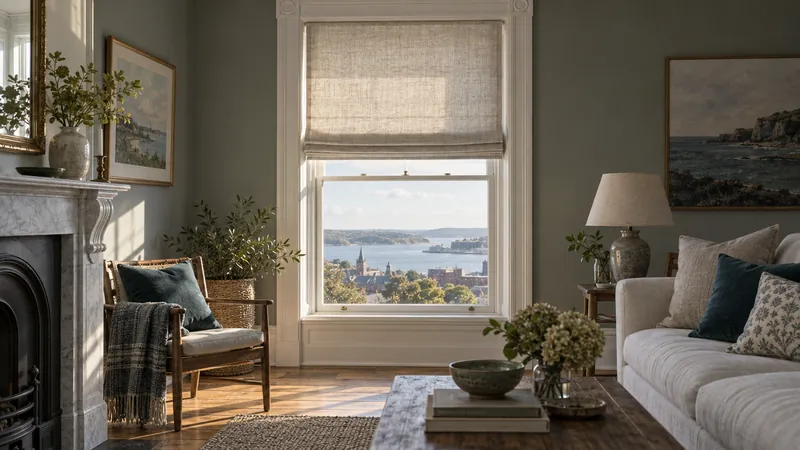
Atlantic Canada's heritage homes
Few regions in Canada have so many old houses still lived in every day. Victorian and Edwardian homes in Halifax's South End and on Young Avenue. The Hydrostone rowhouses, rebuilt after the 1917 Explosion. Saint John's Uptown, rebuilt in brick after the Great Fire of 1877. The row houses of downtown St. John's, many rebuilt after the fire of 1892. Sea captains' houses in Yarmouth and Lunenburg. Downtown Charlottetown, Fredericton's elm-shaded streets, the North End of Sydney, Marysville's mill-town brick rows.
They share a set of window quirks that make off-the-shelf blinds a poor fit.
The challenges
Frames are not square
After a century, houses settle. A window can be several millimetres wider at the top than the bottom, or taller on one side. A stock blind will rub, hang crooked or leave a wedge-shaped gap.
Tall windows
Victorian ceilings were high and windows followed. Tall sashes mean large, heavy shades and long reaches.
Deep casings and original trim
Deep window reveals are great for inside mounts. Original trim is worth protecting; screw holes are forever.
Drafts
Original single-pane sashes, even well-maintained ones with storm windows, lose a lot of heat. Cold air slides off the glass and across the floor.
Odd shapes
Arched tops, transoms, bay windows with narrow side panels, and attic windows under sloped ceilings.
What works best
Lined Roman shades
Soft, tailored and period-appropriate. A thermal or blackout lining adds insulation and protects the fabric from sun. They suit living rooms, dining rooms and primary bedrooms. Roman shades.
Plantation shutters
Interior shutters have been part of North American homes for centuries, and in a Victorian or Edwardian room they look as if they were always there. Tier-on-tier panels give privacy below and light above; frames can be built to take up an out-of-square opening. Hardwood for living rooms and bedrooms, composite for bathrooms and kitchens. Plantation shutters.
Real wood blinds
Natural material that suits old houses. Tilt the slats up to bounce daylight off high ceilings. Best in dry rooms; use faux wood in kitchens and bathrooms. Wood blinds.
Inside-mounted cellular shades
They disappear into deep casings when raised and add serious insulation when lowered. In a neutral fabric, they read as quiet and modern without fighting the architecture. Cellular shades.
Top-down bottom-up for street-facing rooms
Heritage houses often sit close to the sidewalk. Top-down bottom-up shades cover the lower half for privacy and leave the top open to the sky.
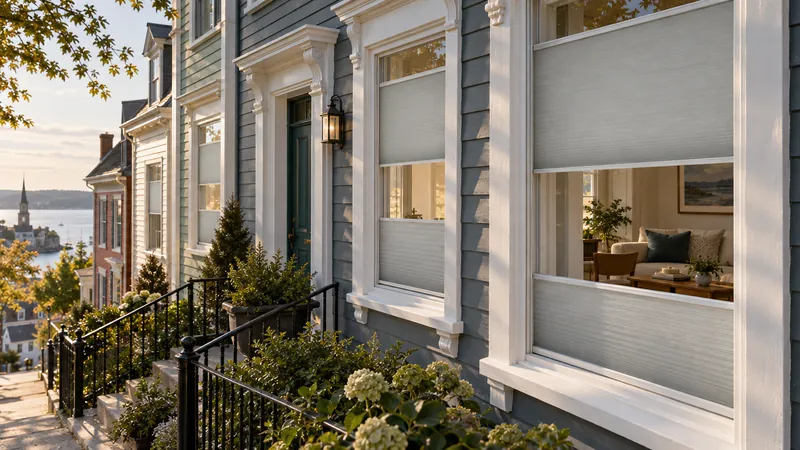
Measuring heritage windows
We measure each window at three points across and three down, record the depth and check the diagonals. For inside mounts, the blind is built to the tightest width so it never rubs. Where a frame is badly out of square, we recommend an outside mount: the shade covers the irregular frame, looks straight, and blocks more cold air at the edges.
Arches, transoms and bays
- Arched tops: usually best left uncovered with a shade on the rectangular part below, or fitted with a fixed, shaped shade. Operable arch shades exist but are rarely worth it.
- Transoms: often left open for light; a fixed shade works if glare is an issue.
- Bays: a matched shade on each section, with side panels sized so shades clear each other when raised.
Warmth without replacing original windows
Many heritage owners want to keep original sashes. Window coverings are one of the best ways to improve comfort without touching the windows themselves:
- Cellular shades with side channels, closed at dusk.
- Lined Roman shades, mounted snugly.
- Exterior or interior storm windows (a separate trade, but a perfect partner).
Heritage rules
Window coverings are inside the house and usually do not need heritage permits in Atlantic Canadian municipalities. But if you live in a heritage conservation district, exterior appearance can matter to you and your neighbours. Many owners choose shades with a white or neutral back so the street view stays consistent.
How we approach this at Atlantic Shades
Heritage homes are some of our favourite work. Our Roman shades are sewn by hand in our Halifax workshop, and every window gets its own measurements. We will also tell you when a window is best left alone.
Frequently asked questions
What window coverings suit a Victorian home?
Lined Roman shades, real wood blinds and inside-mounted cellular shades suit Victorian homes best. They respect the architecture, fit deep casings and add warmth to drafty tall windows.
How do I insulate old windows without replacing them?
Use cellular shades with side channels or lined Roman shades, closed at dusk, and consider storm windows. Together they significantly reduce heat loss through original sashes.
Should blinds go inside or outside the frame in an old house?
Inside, where the casing is deep and reasonably square, to show off original trim. Outside, where the frame is badly out of square or you need maximum darkness and draft control.
Do I need heritage approval for blinds?
Usually not, because window coverings are inside the house. If you live in a heritage district, consider a neutral exterior-facing colour.
What should I do with an arched window?
Usually cover the rectangular section with an operable shade and leave the arch open, or fit a fixed shaped shade over the arch if glare is a problem.
Related: Wood vs faux wood blinds · Are cellular shades worth it? · How to measure for blinds