
Short answer: Choose real wood blinds for living rooms, bedrooms, studies and wide windows where warmth and natural grain matter. Choose faux wood blinds for kitchens, bathrooms, laundry rooms, basements, cottages and busy family rooms, because they resist moisture and wipe clean. In white, the two look very similar from across a room.
Key takeaways
- Real wood is lighter, warmer-looking and better on wide windows.
- Faux wood resists humidity, warping and sticky fingers.
- In damp Atlantic homes and cottages, faux wood is the safer choice for wet rooms.
- Neither is blackout or strongly insulating.
- Many homes use both: wood in living spaces, faux wood in wet rooms.
What they are
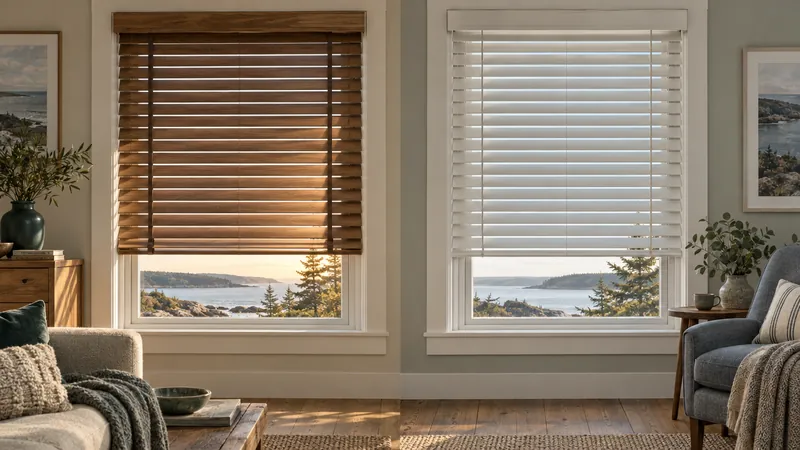
Real wood blinds are made from hardwood slats, usually basswood, a light, stable wood that takes paint and stain well.
Faux wood blinds are made from PVC or a wood-polymer composite, finished to look like painted or stained wood.
Both are horizontal slatted blinds that tilt to direct light and raise to clear the window.
Side by side
| Real wood | Faux wood | |
|---|---|---|
| Look | Natural grain, warm, rich stains | Very close in white; less depth in stains |
| Weight | Lighter | Heavier |
| Widest practical size | Wider | Narrower; very wide windows split into two |
| Moisture | Can warp or lose finish in humidity | Unaffected by steam and humidity |
| Cleaning | Dust; avoid water | Wipe with a damp cloth and mild soap |
| Durability | Can scratch and chip | Tough; resists dents and scuffs |
| Price, installed | About $300 to $750 per window | About $200 to $500 per window |
Where real wood wins
Living and dining rooms. Real wood has a warmth and depth no synthetic matches up close.
Heritage homes. In a Victorian in Halifax's South End or a century home in Saint John, natural materials suit the architecture.
Wide windows. Because real wood is lighter, a single blind can span a wider window without becoming hard to lift.
Rich stains. Walnut, espresso and natural finishes look their best in real wood.
Where faux wood wins
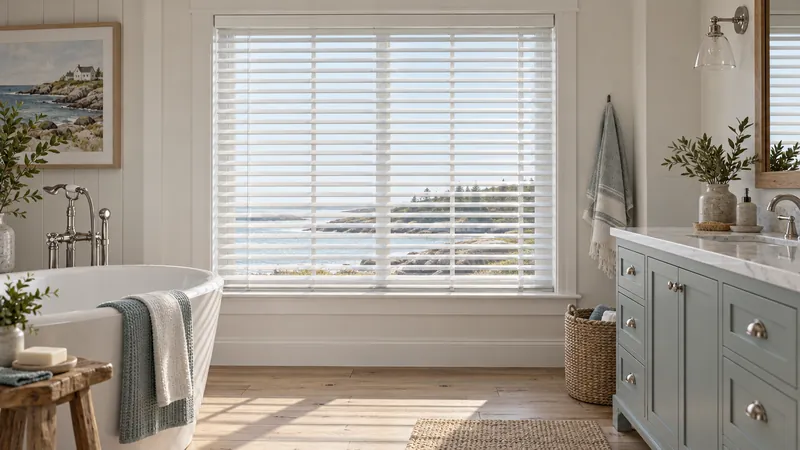
Bathrooms and kitchens. Steam and splashes do not affect it.
Basements and laundry rooms. Damp is part of life in many Atlantic basements.
Cottages. A cottage closed up from October to May gets damp. Real wood can suffer; faux wood does not care.
Kids, pets and rentals. It scuffs less, wipes clean and is cheaper to replace.
Questions we hear a lot
"Will people know it is faux?" In white or off-white, from across the room, almost never. Up close in a dark stain, a careful eye can tell.
"Is faux wood worse for the environment?" It is a plastic product, but it lasts a long time in wet rooms where real wood might need replacing. In dry rooms, real wood is a renewable material and a good choice.
"Can I mix them?" Yes. Matching colours and slat sizes across real wood and faux wood makes the house look consistent.
Upgrades worth knowing
- Cloth tapes replace the cord ladders, hide the cord holes and block more light.
- Route-less slats have no holes, for more privacy and darkness.
- 2.5-inch (6.3 cm) slats give a more open, plantation-style look on larger windows.
- Motorized tilt for hard-to-reach windows.
How we approach this at Atlantic Shades
We usually recommend real wood in living spaces and faux wood in wet rooms, matched in colour and slat size so the house reads as one. In coastal cottages and basements, we steer people to faux wood every time. Both are made to measure in our Halifax workshop.
See wood blinds · See faux wood blinds · Book a free measure
Frequently asked questions
Are faux wood blinds better than wood blinds?
Faux wood is better in humid rooms and busy households because it resists moisture and wipes clean. Real wood is better on wide windows and in living spaces where natural grain and lighter weight matter.
Can real wood blinds go in a bathroom?
We do not recommend it. Steam can warp real wood slats or lift the finish over time. Faux wood or aluminum blinds are better choices.
Which lasts longer, wood or faux wood?
In humid rooms, faux wood lasts longer. In dry rooms, both last many years with basic care.
Are faux wood blinds cheaper?
Yes, typically by about a quarter to a third for the same size.
Do wood or faux wood blinds keep heat in?
Not much. Slatted blinds have gaps between slats. For insulation, cellular shades are far more effective.
Related: Best blinds for bathrooms and kitchens · Window coverings for heritage homes · Best blinds for coastal homes