
Short answer: For an inside mount, measure the width inside the frame at the top, middle and bottom and use the smallest; measure the height at the left, centre and right and use the largest; and check the depth. For an outside mount, measure the area you want to cover and add 5 to 8 cm on each side and above. Use a steel tape and record in millimetres.
Key takeaways
- Decide inside or outside mount before you measure.
- Measure three times each way; older Atlantic homes are rarely square.
- Inside mount: smallest width, largest height. Do not make deductions yourself.
- Outside mount: add overlap for light and draft control.
- Custom blinds cannot be returned. When a company measures, the fit is their responsibility.
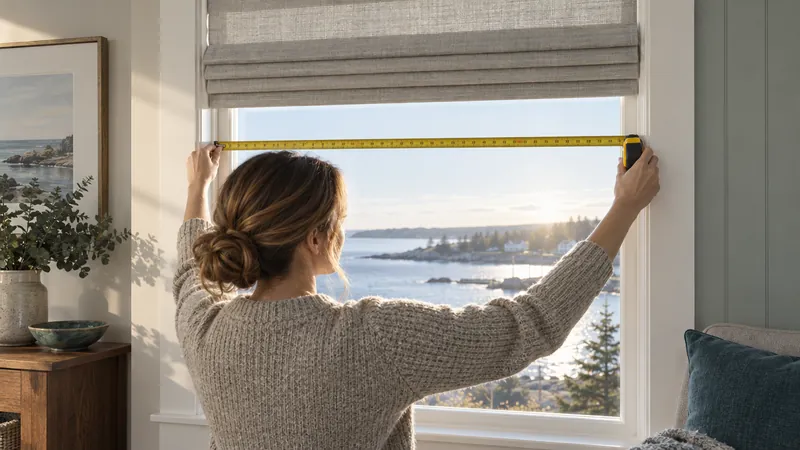
Before you start
You need: a steel tape measure (not cloth), a pencil and paper, and a step stool.
Measure in millimetres. Custom blinds are built to the millimetre. Inches with fractions are where most errors start.
Measure every window. Even windows that look identical are often a few millimetres different, especially in older homes.
Label everything. "Kitchen left," "Kitchen right," "Primary bedroom east." You will thank yourself.
Step 1: Inside mount or outside mount?
Inside mount means the blind sits inside the window frame. It looks clean and shows off the trim.
- Needs enough depth (check the product; many need 2 to 7 cm).
- Leaves small gaps at the sides, which let some light in.
- Not ideal if the frame is badly out of square.
Outside mount means the blind is fixed to the wall or trim above the window and covers the whole opening.
- Better for blackout and drafts, because it overlaps the edges.
- Makes small windows look bigger.
- Hides out-of-square frames.
- Works on shallow frames and windows with cranks or handles that stick out.
Rule of thumb: inside mount for looks in rooms where light gaps do not matter; outside mount for bedrooms, very cold windows and older frames.
Step 2: Measuring for an inside mount
Width
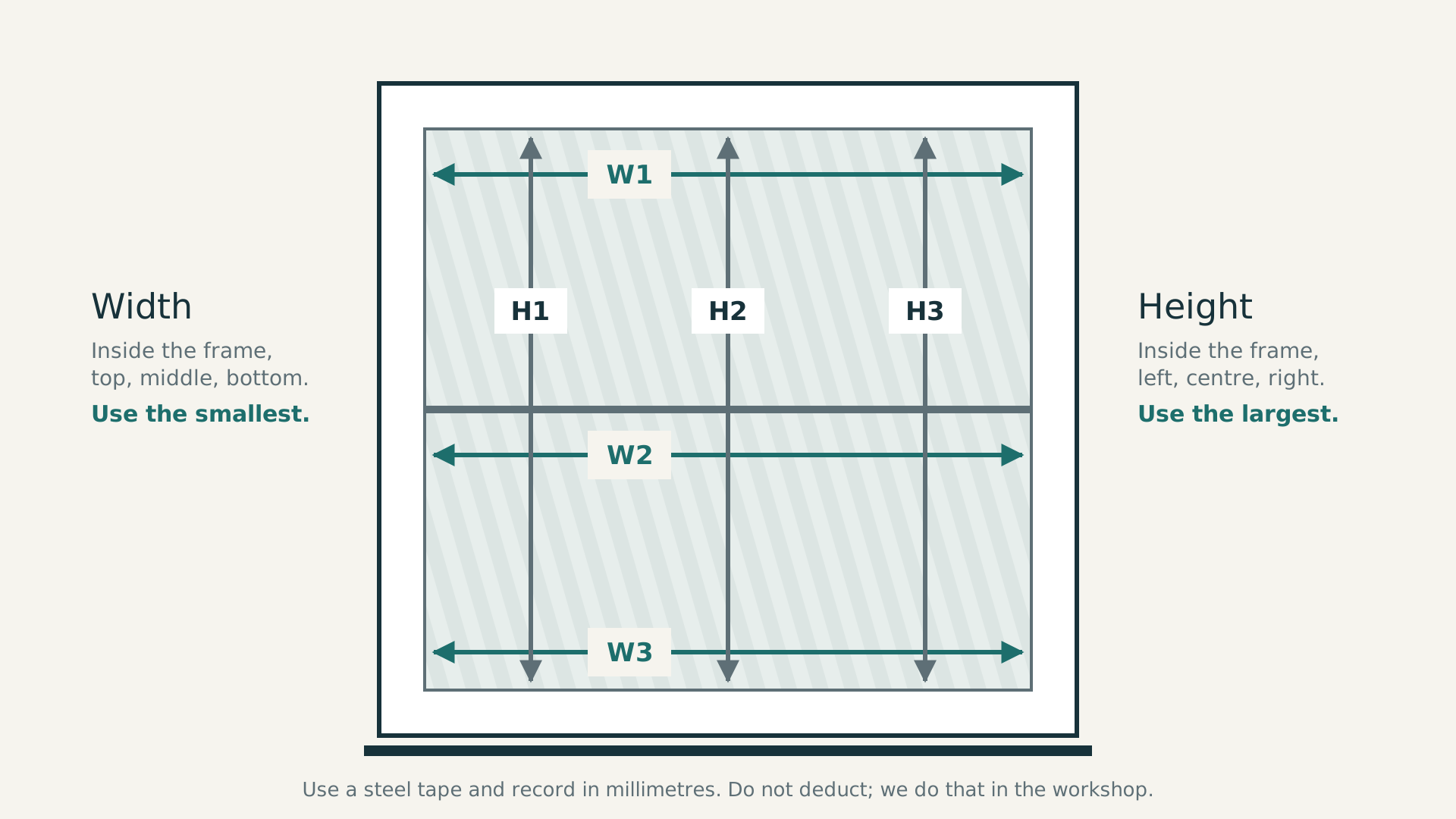
Measure the inside of the frame, from side to side, in three places: at the top, the middle and the bottom. Record the smallest. That is the width that will fit.
Height
Measure from the top inside of the frame to the sill, in three places: left, centre and right. Record the largest. That way the blind reaches the sill everywhere.
Depth
Measure from the glass (or the window's frame) to the front edge of the opening. Compare it with the product's minimum depth. Check for anything that sticks out: cranks, handles, alarm sensors, locks.
Do not deduct
Give the manufacturer the exact inside measurement. They take off the small allowance needed for the blind to operate. If you deduct as well, the blind ends up too narrow.
Step 3: Measuring for an outside mount
Width
Measure the width of the opening (or the outside edges of the trim) and add 5 to 8 cm on each side. More overlap blocks more light and cold air.
Height
Measure from where the headrail will mount, usually 5 to 8 cm above the opening or on the top of the trim, down to where you want the blind to end: the sill, or 5 cm below the opening if there is no sill.
Check the wall
Make sure there is flat wall or trim where the brackets will go, and nothing in the way above the window, such as crown moulding, a curtain rod, or a heating vent.
Step 4: Check for square
Measure the two diagonals of the window opening, corner to corner. If they differ by more than about 6 mm, the frame is out of square. That is very common in older Atlantic homes after a century of settling. For badly out-of-square windows, an outside mount usually looks better and works better.
The mistakes that cost people money
- Using a cloth tape. It stretches.
- Measuring once. Frames vary; three measurements each way catch it.
- Deducting for an inside mount. Leave it to the manufacturer.
- Mixing up width and height. Always width first, then height, and label them.
- Forgetting obstructions. Window cranks on casement windows are the classic. A reverse-roll shade can clear them, but only if you knew to ask.
- Ignoring depth. A blind that sticks out of a shallow frame looks wrong and may not tilt or roll properly.
- Measuring the old blind. Measure the window, not what is on it.
Special windows
- Bay windows: measure each section separately; corner returns need planning so blinds do not collide.
- Patio doors: measure the whole opening plus stack space at the side and handle clearance.
- Arched or angled windows: trace a template or let a professional measure.
- Skylights: these need product-specific measurements. Let a pro do it.
Should you measure yourself at all?
Here is the honest answer. If you buy custom blinds online or from a big-box store, you measure, and if they do not fit, that is on you. Custom blinds are made to your numbers and cannot be resold, so most retailers will not take them back.
When a local company measures for you, the fit becomes their responsibility. At Atlantic Shades, our measure is free, and if we measured it and it does not fit, we remake it. That is the main reason we always measure.
How we measure at Atlantic Shades
Our designers measure every window at three points across and three down, note depth and obstructions, check diagonals for square, and record anything unusual on an order sheet that follows your blinds through our Halifax workshop and out to the installer. In older homes we often recommend an outside mount on the worst windows, which hides the irregular frame and blocks more cold air.
Book a free in-home measure: we bring samples and guarantee the fit.
Frequently asked questions
Should I measure width or height first?
Width first, then height, always. Custom blind companies list sizes as width by height, and mixing them up is one of the most common ordering errors.
Do I deduct for inside mount blinds?
No. Give the exact smallest inside width. The manufacturer makes the small deduction needed for the blind to operate. Deducting yourself makes the blind too narrow.
How much should an outside mount overlap the window?
Add 5 to 8 cm on each side and above. More overlap blocks more light and drafts, which matters in bedrooms and cold rooms.
What if my window is not square?
If the diagonals differ by more than about 6 mm, consider an outside mount, which hides the irregular frame. For inside mounts, use the smallest width and largest height.
What if my measurements are wrong?
If you measured, custom blinds usually cannot be returned. If a company like Atlantic Shades measured, it is their responsibility to remake them.
Related: How much do custom blinds cost? · Custom vs ready-made blinds · Window coverings for heritage homes