
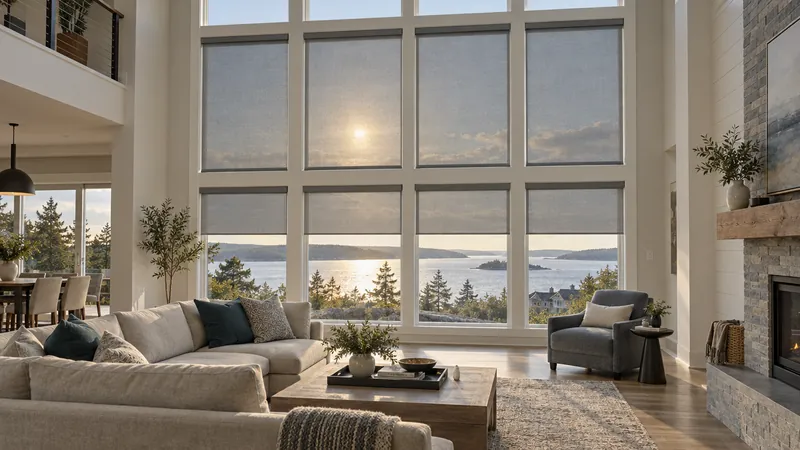
Short answer: For large and tall windows, motorized roller, solar or cellular shades are usually the best choice: they handle the size, remove the need for poles or ladders, and can follow a schedule. Solar fabric controls the glare from low winter sun while keeping the view. Very wide glass works best as several matched shades lined up with the window frames and controlled as one group.
Key takeaways
- Fabric has width limits; most shades top out around 2.4 to 3 m.
- Split wide glass at the mullions so shades read as one line.
- Motorize anything you cannot comfortably reach.
- Low Atlantic winter sun makes glare the main problem on big south and west glass.
- Skylights need side channels to hold fabric flat.
Why big windows are harder than they look
New homes across Atlantic Canada have more glass than ever. Two-storey great rooms in Bedford South and Hammonds Plains, floor-to-ceiling condo windows in downtown Halifax and Moncton, ocean-facing window walls on the South Shore and the Avalon, lake-view living rooms in Fall River and Quispamsis.
Big glass brings three problems:
- You cannot reach it.
- Standard products have size limits.
- Light and heat scale with the glass. More window means more glare, more summer heat and more winter heat loss.
The glare problem, Atlantic edition
At noon on December 21 the sun sits just 22 degrees above the horizon in Halifax, 21 in Moncton and Fredericton, 20 in Charlottetown and 19 in St. John's. At that angle, light does not fall on the floor by the window; it travels straight across the room. A big south- or west-facing window means glare on the TV, in your eyes and across the kitchen island for much of the short winter day.
Roof overhangs designed to shade windows in summer do nothing about it. See the sun angle for your town.
Best options for large windows
Solar shades
A woven screen fabric that cuts glare and heat while keeping the view. Choose 3% openness for most rooms and 1% for strong direct sun. Darker colours give the clearest view. Solar shades.
Roller shades
The simplest way to cover big glass, from sheer to blackout. Larger tubes keep wide fabric straight. Roller shades.
Cellular shades
For big windows that lose heat, especially north-facing glass. Cellular shades.
Dual rollers
Solar for day, blackout or privacy for night, on one bracket.
Panel tracks
Wide fabric panels that slide sideways, for window walls and sliding glass.
Size limits and how to work with them
Most shade fabrics come on rolls about 2.4 to 3 m wide. Beyond that you either need a premium extra-wide fabric, a seam (which can show), or more than one shade.
Splitting a wide window into two or three shades is often better anyway:
- Line the splits up with the window's mullions so the shades look like part of the architecture.
- Each shade is lighter, so motors and lifts last longer.
- You can raise one section and leave the others down.
- Group them on one remote or app so they still move as one.
Tall windows
- Under about 2.5 m from the floor: cordless shades can work if you can reach the bottom rail.
- Above that: motorize. A long chain on a tall window is clumsy and a pole is a nuisance.
- Two-storey glass: stacked shades for the upper and lower sections, or one tall shade on a larger tube, both motorized.
Skylights
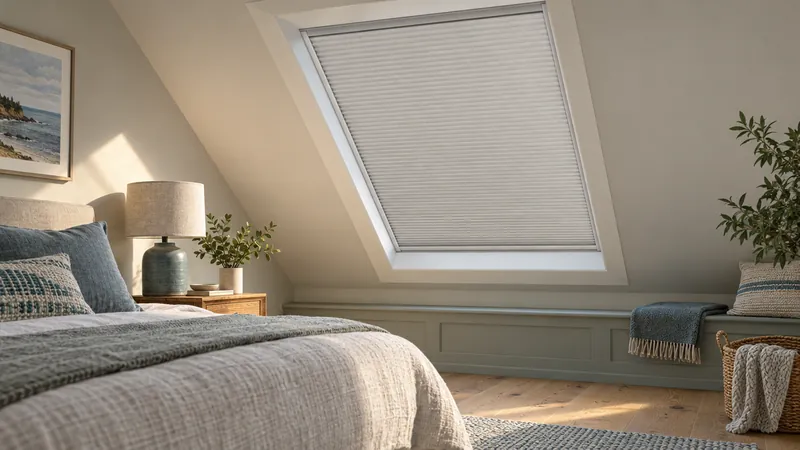
Skylights need products designed for them. Cellular skylight shades run in side channels that hold the fabric flat against angled or overhead glass. Choose blackout for bedrooms and light-filtering for living areas. Most are motorized, often with a small solar panel so they never need charging.
Angled and shaped windows
Gable-end triangles, trapezoids and arches are common in modern Atlantic homes. Some are best with fixed shades that never move, some with custom-angled operable shades, and some are best left uncovered. A good installer will tell you which.
Why motorization is almost always worth it here
On big glass, motorization is less a luxury and more the thing that makes shades usable. Add schedules and sun sensors and the shades handle glare and heat on their own: lowering when the afternoon sun hits the great room in December and rising again when it moves on. Are motorized blinds worth it?
How we approach this at Atlantic Shades
We measure big glass carefully, plan splits around the mullions, choose tube sizes for the fabric weight, and usually recommend motorization with grouped controls. For new builds, we supply wiring specs so hardwired motors can go in before drywall. Every shade is made in our Halifax workshop.
See skylight and large window solutions · Book a smart home consultation
Frequently asked questions
What are the best blinds for very large windows?
Motorized roller, solar or cellular shades, usually split into several matched shades lined up with the window frames and grouped on one control. Solar fabric is best for glare; cellular for heat loss.
Can one shade cover a very wide window?
Usually up to about 2.4 to 3 m, depending on fabric. Wider windows look and work better with two or more shades.
What blinds stop glare but keep the view?
Solar shades. A 3% openness in a dark colour cuts most glare while keeping a clear view during the day.
How do you cover a two-storey window?
With motorized shades, either one tall shade on a larger tube or stacked shades for the upper and lower sections, controlled together.
Can skylights have blinds?
Yes. Cellular skylight shades run in side channels to stay flat on angled glass, and are usually motorized.
Related: Are motorized blinds worth it? · Smart blinds for Google, Alexa and HomeKit · Best blinds for sliding patio doors